The Hash of Hashes
The Quiet Data Structure Running the Internet
Every time you type git commit, you plant a tree. Not a metaphor — an actual tree of cryptographic hashes. The same shape lets Bitcoin agree on who owns what, lets your browser trust a padlock, and lets a backup tool sync a 4 GB folder without re-uploading 4 GB. It has a name most people never learn: the Merkle tree.
Ralph Merkle described it in 1979, in a Stanford PhD thesis that was mostly about something else. It sat quietly for decades. Then the internet grew up, discovered it needed to answer one question a trillion times a second, and reached for the exact tool Merkle had already left on the shelf.
The problem, before the trick
Say I hand you a million files and claim they're identical to my million files. How do you check?
The obvious way is to compare them one by one. A million comparisons. Do it again tomorrow when one file might have changed, and you're back to a million comparisons to find the single needle.
The slightly cleverer way is to hash everything. A hash function takes any input and spits out a short fixed-length fingerprint — change one byte of the input and the fingerprint scrambles completely.
The box below runs real SHA-256 — the same algorithm inside Git and Bitcoin — right in your browser. Type. Add a period. Fix a typo. Watch the bottom line thrash.
Every keystroke re-hashes. Each green digit is one that now differs from the original fingerprint — watch one tiny edit flip almost all of them, and reverting your text clear them again.
So I hash all million files, glue the hashes together, hash that, and hand you the single final number. If your number matches mine, our files match. One comparison instead of a million.
But this cheap version has a cruel flaw: when the numbers don't match, it tells you nothing about where. One byte drifted in one file and the whole fingerprint changed. You're back to square one, hunting through a million files with no map.
The Merkle tree is what you get when you fix exactly this.
The trick
Instead of hashing everything into one flat number, you hash in layers.
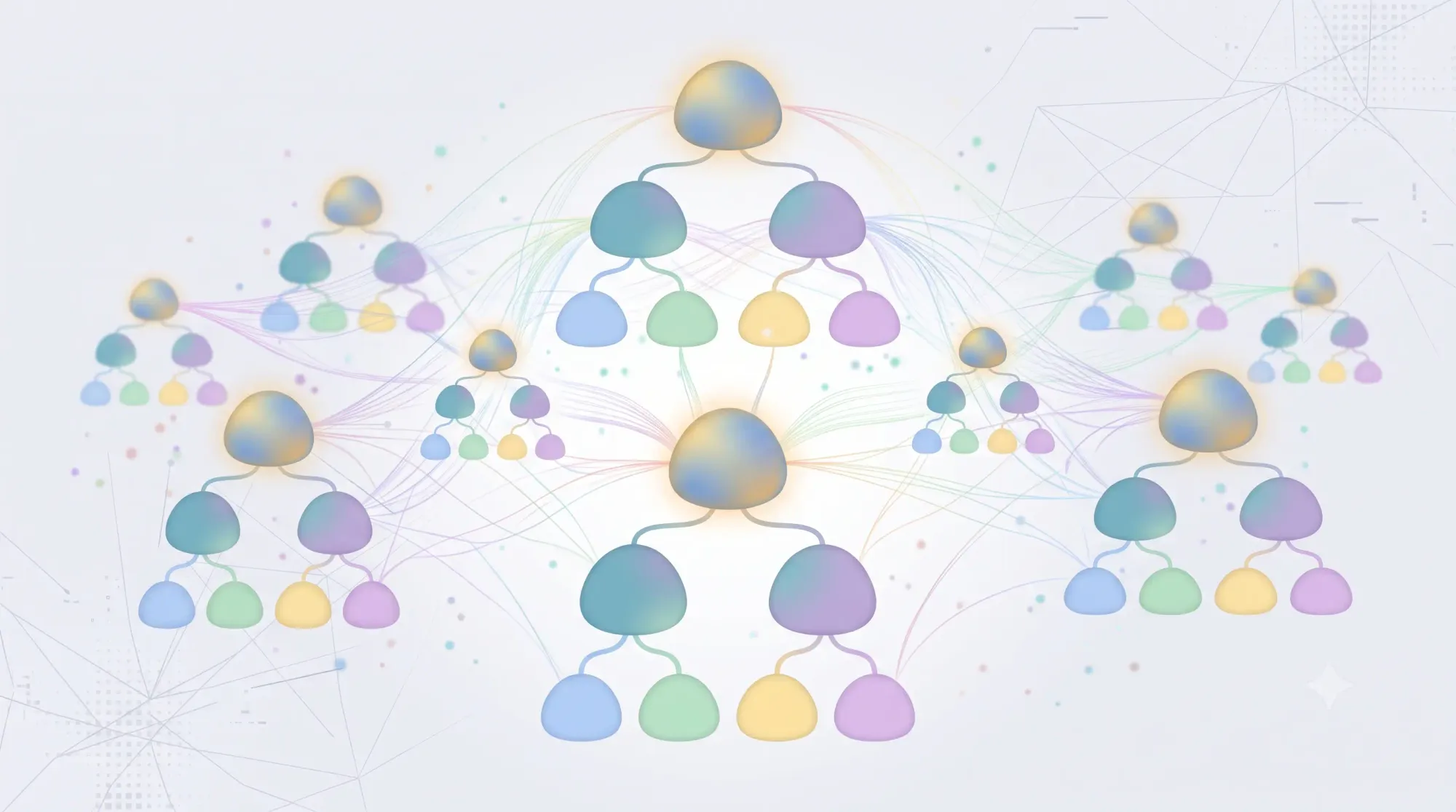
Hash each file individually — that's the bottom row of leaves. Then pair up the leaves and hash each pair together, making a smaller row above. Pair up those and hash again. Keep going until you're left with a single hash at the top. That top hash is called the Merkle root, and it depends, transitively, on every single leaf beneath it.
                root
              /      \
          H(01)      H(23)
          /   \      /   \
        H0    H1    H2    H3
        |     |     |     |
      file0 file1 file2 file3
Now change one byte in file2. H2 changes. That forces H(23) to change, which forces the root to change. The tampering ripples straight up one path to the top — and only that path. H0, H1, and H(01) never move.
Below is a living one, built over four records in a tiny ledger. Change one record — tamper with a balance, rename someone — and watch what happens.
Each leaf is a record in a small ledger. Tamper with any one — bump a balance, change a name — and its fingerprint changes, which forces its parent to change, which forces the root to change. The damage travels one path to the top, and only that path, so the forgery is impossible to hide.
The tampered record's hash changes. That forces its parent to change, which forces the root to change. The damage ripples straight up one path to the top — and only that path. Every untouched record's fingerprint stays exactly where it was.
So when your root disagrees with mine, we don't shrug and re-check everything. We walk down the tree, following only the branches where our hashes differ. Left side matches? Prune it, ignore half the files instantly. In a million-file tree we find the one changed file in about twenty comparisons instead of a million. The cost went from linear to logarithmic — the same leap that makes binary search feel like magic.
That's the whole idea. A tree where every node is the hash of its children. Once you have it, three superpowers fall out almost for free.
Superpower one: Git is a Merkle tree wearing a trench coat
Open any Git repo and you're staring at one. Git stores four kinds of object, and every one is addressed by the hash of its own content. A blob is a file's contents. A tree lists filenames alongside the hashes of the blobs and sub-trees inside a directory. A commit points to one top-level tree plus its parent commits. Hashes pointing to hashes pointing to hashes — a Merkle tree (technically a Merkle DAG, since history branches and merges).
This is why Git does what it does. Revert a file to an old version and commit again — Git notices the blob's hash already exists and stores nothing new. Two identical files anywhere in history share one blob. And the reason a commit SHA feels trustworthy is that it is: change one character in one file from ten years ago, and every commit hash from that point forward stops lining up. The history is tamper-evident by construction. You didn't opt into cryptographic integrity; it was the data structure the whole time.
Superpower two: proving membership without the whole set
Here's the move that powers Bitcoin. A Bitcoin block can hold thousands of transactions, but the block header — the tiny part every node gossips and stores — carries just the Merkle root of them all.
Now suppose your phone wants to confirm that one payment made it into a block, without downloading the entire blockchain (hundreds of gigabytes). It doesn't have to. It asks a full node for a Merkle proof: your transaction's hash, plus the handful of sibling hashes along the path from your leaf up to the root. Click any transaction below to see exactly which hashes that proof needs — and, just as tellingly, how many it doesn't:
Bright = the leaf you're proving. Green = the sibling hashes the verifier is handed. Muted = data they never need to see.
Roughly a dozen hashes for a block of thousands of transactions. Your phone recomputes the path, checks that it lands on the root already in the trusted header, and it's done. Mathematically certain your transaction is in there, having downloaded almost nothing. Bitcoin calls this Simplified Payment Verification, and it's the reason a lightweight wallet can exist at all.
The same proof shape shows up in quieter places. Certificate Transparency logs — the public ledgers that keep certificate authorities honest, so no one can secretly mint a certificate for your bank — are append-only Merkle trees. Your browser can demand cryptographic proof that a certificate was logged, and proof that the log never rewrote its own past, all in a few kilobytes.
Superpower three: syncing two machines that barely talk
Databases like Amazon's DynamoDB and Apache Cassandra store copies of your data on several machines. Networks being networks, those copies drift apart. Reconciling them by shipping every row across the wire would be absurd.
So they build a Merkle tree over each replica's data and compare roots. Roots match? The replicas are identical — conversation over, near-zero bytes sent. Roots differ? Walk down only the mismatched branches and sync just the ranges that actually diverged. This anti-entropy repair is why a distributed database can stay consistent without melting the network. The same logic quietly de-duplicates your backups and lets peer-to-peer filesystems like IPFS and BitTorrent v2 fetch only the chunks you're missing.
The pattern under the pattern
Once the shape clicks, you start seeing it everywhere, and it's always answering a version of the same question: are these two things the same, and if not, where exactly do they differ — and can you prove it cheaply?
Git asks it about your code. Bitcoin asks it about money. Certificate Transparency asks it about trust. Cassandra asks it about replicas. ZFS asks it about the bits on your disk rotting in the dark. Different words, one data structure — a tree where every parent is the fingerprint of its children.
There's something worth sitting with here. The Merkle tree isn't a clever optimization someone bolted on. It's closer to a natural law of information: the cheapest honest way to summarize a lot of data into one small number, such that the number betrays any lie and points to where the lie lives. Merkle wrote it down in 1979 as a footnote to a signature scheme. The internet spent forty years accidentally rediscovering that it couldn't function without it.
We tend to think the hard problems get solved by inventing something new. More often, someone already left the right idea on a shelf — and the real work is noticing we've been reaching for it all along.